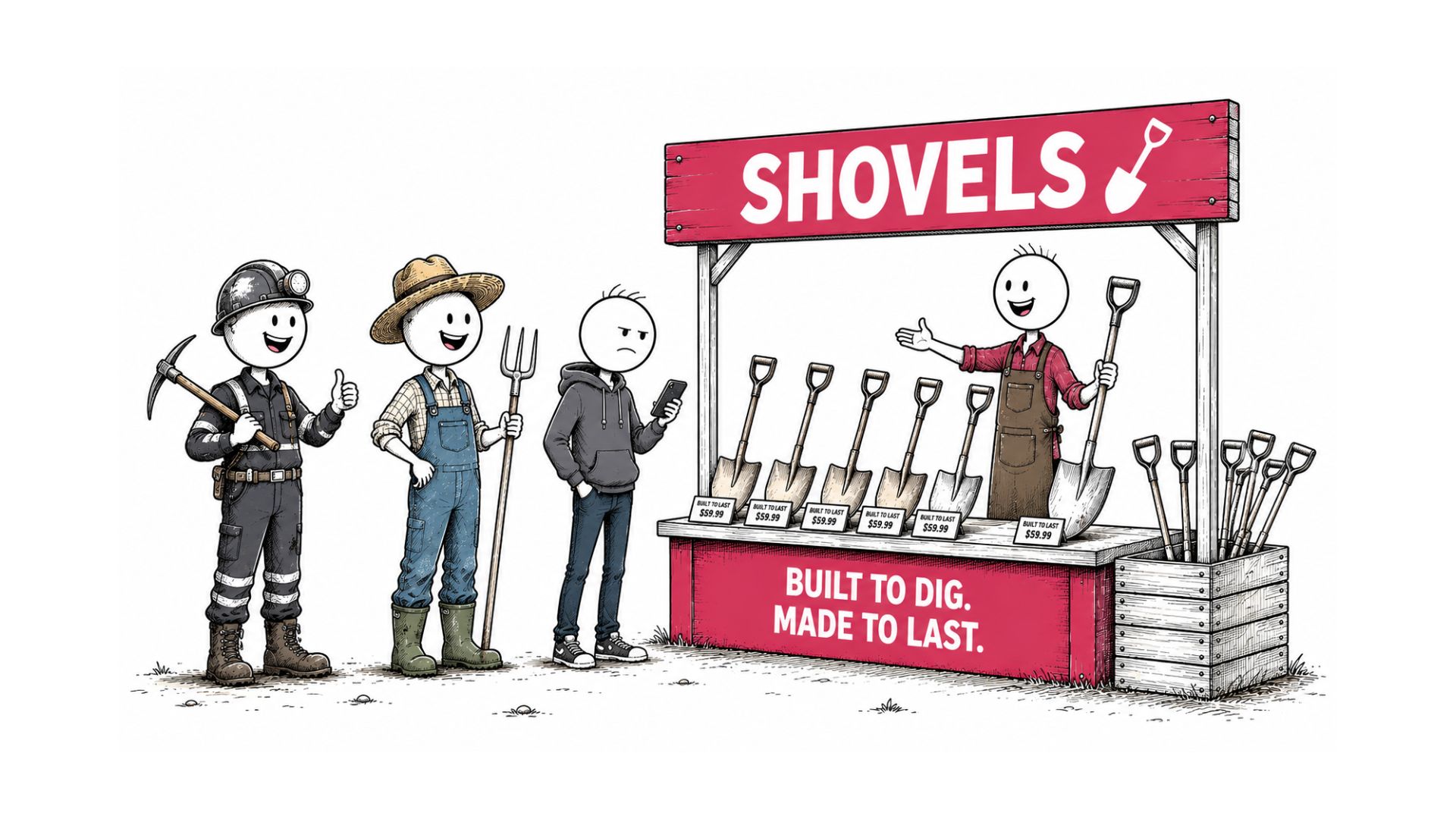
When I first started learning about startups, I had a completely different understanding of product-market fit than I do today. I assumed that product-market fit was something companies achieved after they became successful. Whenever I read stories about startups raising large funding rounds, reaching impressive revenue milestones, attracting media attention, or growing rapidly, I believed those achievements were evidence that the company had eventually found product-market fit. In my mind, success came first and product-market fit followed as a natural consequence of that success.
As I spent more time studying startups, founders, and business case studies, I gradually realized that I had misunderstood the relationship between success and product-market fit. The companies I admired did not become successful and then discover product-market fit. In many cases, they found product-market fit first, and the growth, revenue, funding, and recognition came afterward. Product-market fit was often the foundation that made everything else possible. It was not the reward for success but the reason success became achievable in the first place.
This realization completely changed the way I think about startups. Instead of focusing primarily on growth metrics, fundraising announcements, or marketing strategies, I became more interested in understanding how founders identified meaningful problems and built products that people genuinely wanted. The more I learned, the more I noticed that successful founders spent an enormous amount of time studying their users. They listened carefully to complaints, observed behavior patterns, paid attention to frustrations, and tried to understand problems at a deeper level than most people. What initially looked like ordinary customer research was often the process through which product-market fit was discovered.
Understanding What Product-Market Fit Really Means
The simplest way I think about product-market fit is not through a textbook definition but through a recurring pattern that appears across many successful startups. A founder identifies a problem that people genuinely care about, creates a solution that addresses that problem effectively, and then notices that users continue returning because the product provides real value. Over time, the product becomes part of the user’s routine and starts solving an important need consistently. When that happens, the relationship between the product and its users begins to change in meaningful ways.
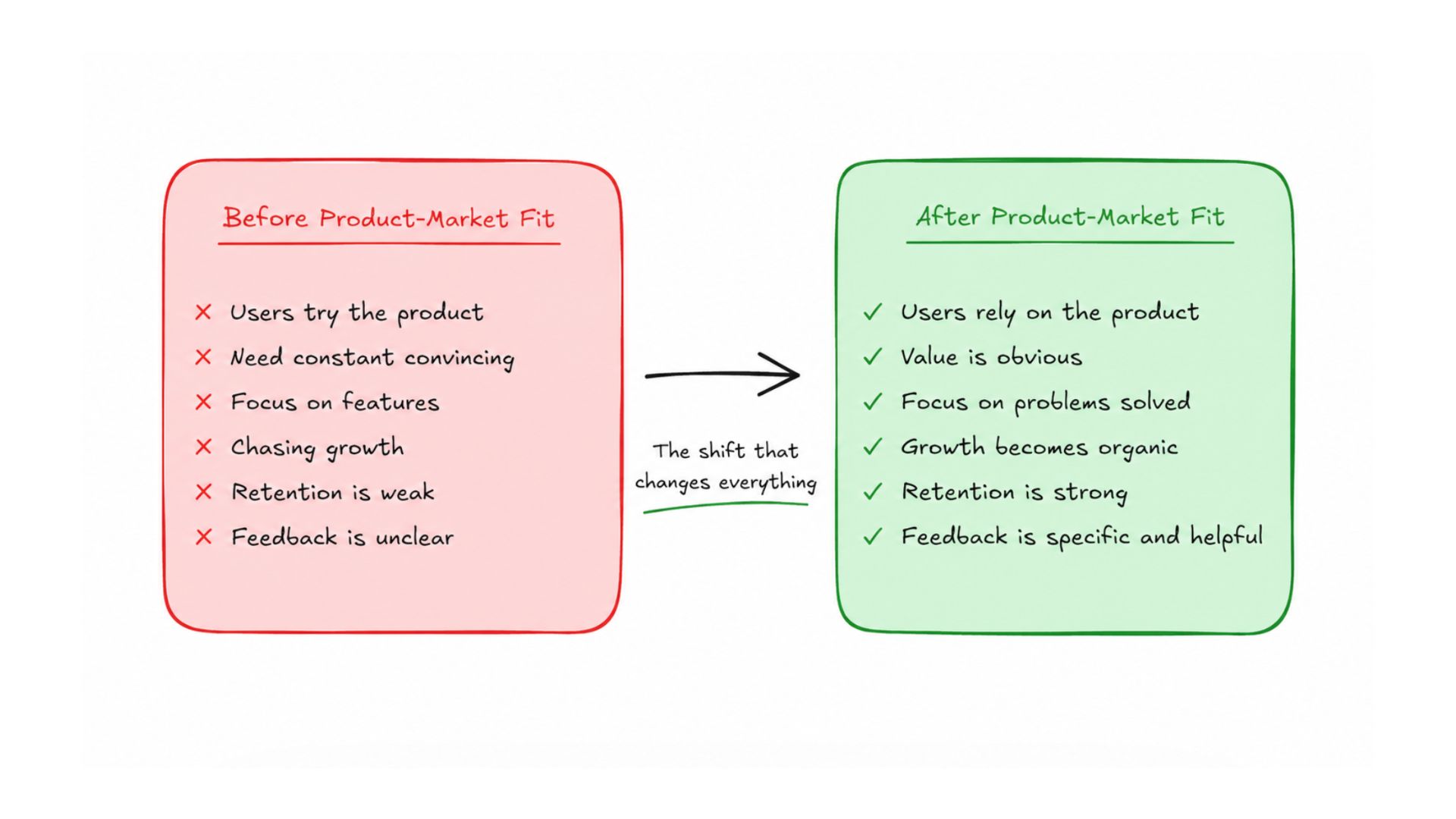
In the earliest stages of a startup, founders often spend a significant amount of time explaining why their product matters. They need to convince people to try it, educate potential users about the problem being solved, and gather feedback to determine whether anyone truly cares about the solution. During this phase, uncertainty is everywhere because the founder is still trying to validate assumptions. However, when product-market fit begins to emerge, the nature of user conversations changes. Instead of asking why the product exists, users start discussing how it can be improved. Rather than questioning its relevance, they begin suggesting features, sharing use cases, and integrating it into their daily activities.
A few common signs of this shift include:
- Users returning consistently without being reminded.
- Feedback becoming more specific and actionable.
- Organic referrals increasing over time.
- Customers integrating the product into their routines.
This shift may appear subtle, but it often signals that the product is becoming genuinely valuable.
Another important aspect of product-market fit is that it rarely arrives as a dramatic breakthrough moment. Before learning more about startups, I imagined product-market fit as a sudden event where growth exploded overnight and every challenge became easier. In reality, many founders describe it as a gradual process rather than a single milestone. User retention slowly improves, referrals become more common, engagement increases, and feedback becomes more detailed and constructive. There may not be a specific day when everyone realizes product-market fit has been achieved, but over time the evidence becomes increasingly difficult to ignore because users continue finding value in the product.
Why Product-Market Fit Is Often Misunderstood
One reason product-market fit is frequently misunderstood is that founders and observers often focus on metrics that are easy to measure rather than indicators that reveal genuine user value. Signups, website traffic, social media engagement, downloads, and media mentions are all visible and easy to track. While these metrics can provide useful information, they do not necessarily indicate whether people truly need the product or whether it solves an important problem in their lives.
A startup can attract thousands of visitors simply because people are curious about a new idea. It can receive significant attention because the concept sounds innovative or because a marketing campaign generates excitement. Some products even experience viral growth for a short period without creating lasting value for users. Although these outcomes may look impressive on the surface, they do not guarantee that users will continue returning after the initial excitement fades. Sustainable success depends on whether people consistently find the product useful enough to make it part of their routine.
This is why I have become far more interested in user behavior than user enthusiasm. Excitement can be temporary and often reflects curiosity rather than commitment. Behavior, on the other hand, reveals what people actually value. When users repeatedly return to a product, continue using it over long periods, and integrate it into their daily lives, they are demonstrating genuine demand.
Some metrics often mistaken for product-market fit include:
- High website traffic
- Viral social media attention
- Large numbers of downloads
- Temporary spikes in signups
Those actions provide stronger evidence of product-market fit than temporary spikes in traffic or social media attention.
The Difference Between a Good Product and a Needed Product
One of the most surprising lessons I learned from studying startup failures is that many unsuccessful products were not necessarily poorly built. Some had talented teams, attractive designs, sophisticated technology, and substantial funding. Despite these advantages, they struggled because they addressed problems that people did not care enough about. The products themselves may have been impressive, but the underlying demand was weak.
This observation changed the way I evaluate startup ideas. Earlier, I believed the quality of an idea depended largely on how innovative or unique it sounded. Today, I think a much better question is whether the problem occurs frequently enough in people’s lives to justify a solution. A simple product that solves an important and recurring problem can create far more value than a highly innovative product that addresses an issue few people actually experience. Many successful startups appear obvious in hindsight because they focused on solving problems that users were already struggling with every day.
The importance of solving meaningful problems becomes even clearer when examining long-term business success. Companies that achieve lasting growth often build products around persistent customer needs rather than temporary trends. They focus on:
- Reducing friction
- Saving time
- Lowering costs
- Improving convenience
- Eliminating recurring frustrations
Because these problems are real and recurring, users continue finding value in the solution over time.
The Challenge of Early Feedback
Another lesson I learned is that founders often receive feedback that can be misleading during the early stages of building a startup. Most people naturally want to be supportive and encouraging. When presented with a new idea, they may say it sounds interesting, useful, or promising. They may express enthusiasm and claim they would probably use the product in the future. While these conversations can boost confidence, they do not always predict actual behavior.
The real test begins after the conversation ends. What matters is not whether people say they like the idea but whether they take meaningful action. Questions like these often reveal the truth:
- Do they sign up when given the opportunity?
- Do they return after their first experience?
- Do they continue using the product weeks or months later?
- Do they recommend it to friends, colleagues, or family members?
These behaviors provide much stronger evidence of genuine demand than verbal encouragement alone.
Many founders discover that there is often a significant gap between what people say and what they actually do. Someone may genuinely believe they would use a product, but when faced with real-world priorities and competing alternatives, their behavior may tell a different story. This is why observing actions is often more valuable than collecting opinions. Product-market fit is ultimately reflected in behavior, not compliments.
Product-Market Fit Is Not a Permanent Destination
Another misconception I once had was viewing product-market fit as a final destination that a startup either reaches or fails to reach. The more I learn about business and technology, the more I believe product-market fit should be viewed as an ongoing process rather than a permanent achievement. Markets evolve, customer expectations change, competitors emerge, and technology continues advancing. A product that perfectly fits market needs today may require significant adaptation in the future.
The most successful companies understand this reality and continuously invest in understanding their users. They do not assume that past success guarantees future relevance. Instead, they remain curious about changing customer needs and actively seek opportunities to improve their products. By maintaining close relationships with users and staying responsive to market shifts, they preserve and strengthen their product-market fit over time.
This perspective highlights the importance of continuous learning. Product-market fit is not something a company discovers once and then forgets about. It requires ongoing attention, experimentation, and adaptation. Businesses that stop listening to customers often find themselves losing relevance, while those that remain focused on user needs are better positioned to sustain growth.
A Simple Question That Reveals a Lot
One of the most useful ways I think about product-market fit comes from a simple question: if the product disappeared tomorrow, would its users genuinely care? I find this question powerful because it cuts through many of the distractions and vanity metrics that often dominate startup discussions.
People can be curious about a product without needing it. They can enjoy using it occasionally without depending on it. They can try it once and never return. None of these situations necessarily indicate strong product-market fit. However, when users would feel frustrated, inconvenienced, or disappointed if the product suddenly vanished, it suggests that the product is creating meaningful value in their lives.
A product that users genuinely miss is usually solving an important problem or fulfilling a significant need. It has moved beyond novelty and become something people rely on. This level of dependence often provides a much clearer indication of product-market fit than growth charts, download numbers, or social media engagement statistics.
The Real Path to Product-Market Fit
The biggest lesson I have taken away from studying product-market fit is that founders often discover it by becoming dedicated students of their users. They spend time understanding customer problems, observing behavior patterns, testing assumptions, gathering feedback, and continuously improving their products. Although this process sounds straightforward, it requires patience, persistence, and a willingness to challenge assumptions repeatedly.
Many startup success stories create the impression that growth happens quickly and effortlessly. In reality, product-market fit is often the result of countless conversations, experiments, observations, and refinements. Founders gradually learn what users truly need, eliminate unnecessary features, improve the user experience, and strengthen the value their product provides. Over time, these small improvements accumulate and create a product that people genuinely want to keep using.
The journey often involves:
- Listening carefully to users
- Testing assumptions continuously
- Measuring real user behavior
- Refining the product based on feedback
- Staying focused on solving meaningful problems
Whenever I read about successful startups today, I pay far less attention to funding announcements, valuation figures, or growth headlines than I did in the past. What interests me most is understanding why users continued returning to the product. In many cases, the answer is surprisingly simple. The company identified a real problem, built a solution that addressed it effectively, listened carefully to users, and continuously improved the product based on what it learned. As a result, people found genuine value in the solution and kept using it.
Users Don’t Care About Your Startup, They Care About Their Problem
Looking back, I now see product-market fit as one of the most important concepts in entrepreneurship because it sits at the center of sustainable business growth. It represents the point where a product solves a meaningful problem for a specific group of people in a way that creates lasting value. When that happens, growth becomes easier, customer acquisition becomes more efficient, referrals become more common, and the business gains a stronger foundation for long-term success.
Everything that people typically associate with startup success often follows from this underlying reality, which is why understanding product-market fit correctly can completely change the way founders approach building companies.

Adarsh is the founder and editor of Yeamt, where he breaks down AI, startups, funding, developer tools, and emerging technology into clear, practical explainers for founders, builders, and tech readers.