
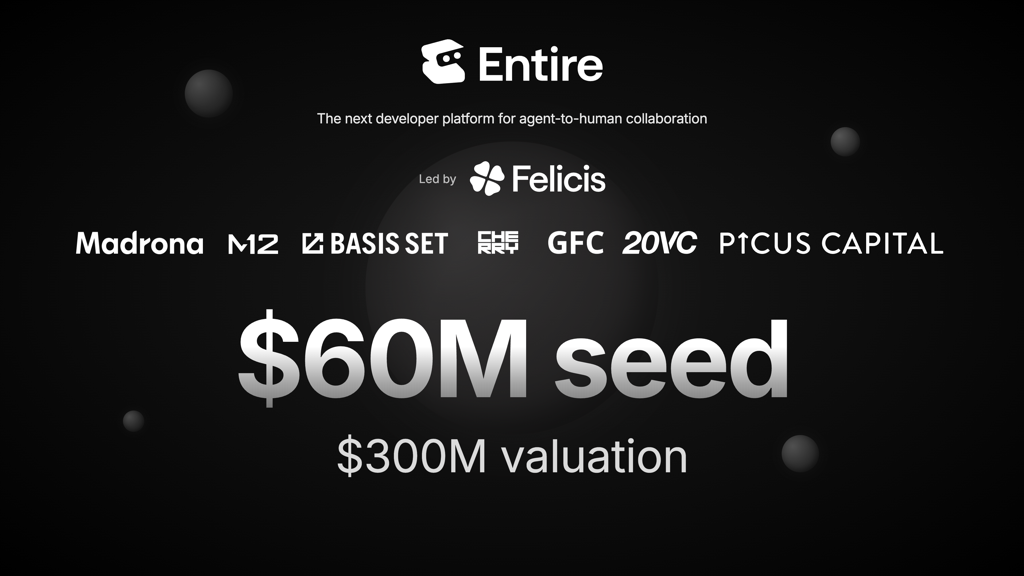
Former GitHub CEO Thomas Dohmke has announced the launch of Entire, a new developer platform built specifically for collaboration between humans and AI agents. The company launches with a $60 million seed round at a $300 million valuation, making it one of the largest seed investments ever raised in the developer tools category and the largest seed round in the sector’s history.
The round was led by Felicis, with participation from Madrona, M12, Basis Set, 20VC, Cherry Ventures, Picus Capital, and Global Founders Capital. Entire is also backed by individual investors including Gergely Orosz, Theo Browne, Jerry Yang, Olivier Pomel, and Garry Tan. Collectively, the group reflects deep experience across developer platforms, open source, infrastructure, and AI, signaling a strong belief that software development is entering its next major platform shift.
Entire is being built in response to a structural change in how software is created. In recent months, agentic coding systems such as Claude Code, advanced GPT-based coding agents, and multi-agent developer tools have fundamentally reshaped the role of the developer. The terminal is becoming the new center of gravity, with developers orchestrating fleets of agents across multiple sessions. Spec-driven development is increasingly replacing hands-on coding, while agents operate in parallel, generating and evaluating hundreds of variants at once. As a result, massive volumes of code are being produced faster than any human can reasonably understand.
At the same time, the software development lifecycle remains rooted in workflows designed for human-to-human collaboration. Issues were created for manual planning, not as structured, machine-readable units of work. Git repositories were never extended to version intent or reasoning. Pull requests struggle to scale in large monorepos. Agent sessions are ephemeral, with prompts and decisions disappearing the moment a terminal closes. This mismatch is creating real bottlenecks, forcing agents to retrace steps, duplicate reasoning, waste tokens, and lose shared understanding over time.
“We’re seeing a fundamental mismatch between how software is produced today and the tools we rely on to manage it,” said Dohmke. “Entire is about rebuilding the developer platform so humans and agents can work together with shared context, understanding, and accountability.”
The company’s vision centers on three foundational elements.
First, a git-compatible database that unifies code, intent, constraints, and reasoning as first-class, version-controlled data.
Second, a universal semantic reasoning layer that enables coordination across multiple agents through a shared context graph, allowing agents to collaborate without collision or duplicated work.
Third, an AI-native software development lifecycle and interface, designed from the ground up for agent-to-human collaboration rather than retrofitting agents into human-centric workflows.
Alongside the company launch, Entire is releasing its first product as open source. Checkpoints is a CLI tool that automatically captures AI agent context on every Git commit. This includes prompts, reasoning, decisions, transcripts, files touched, tool calls, and token usage, information that is typically lost once an agent session ends.
With Checkpoints, each agent-generated commit is paired with a structured checkpoint stored directly in Git and pushed to a dedicated, append-only branch. This creates a durable audit log inside the repository, allowing developers to inspect not just what changed, but why it changed. The captured context can be browsed by branch, drilled into at the session level, traced across commits, and explored through a dedicated user interface and contribution graph.
Checkpoints are useful immediately:
- Traceability – inspect the reasoning behind any agent-generated change
- Faster reviews – review intent and constraints, not just diffs
- Better handoffs – resume work without replaying prompts or sessions
- Less token waste – agents avoid repeating mistakes corrected in past sessions
- Multi-session and agent support – handle concurrent agentic workflows
At launch, Checkpoints supports Anthropic’s Claude Code and Google’s Gemini CLI. Support for additional agents, including Codex and Cursor-based tooling, is planned as Entire prepares for the broader release of its full platform later this year.
Entire is a remote-first, globally distributed company with 15 employees and decades of experience building developer tools at organizations such as GitHub and Atlassian. The company plans to expand rapidly over the coming months, growing to more than 30 engineers, operating alongside hundreds of internal AI agents, and continuing to build in the open with feedback from the developer community.
Entire’s long-term goal is to create a new foundation for software development in the age of AI agents, where humans and machines collaborate with shared memory, durable context, and clear intent to build, understand, and ship software together.

Adarsh is the founder and editor of Yeamt, where he breaks down AI, startups, funding, developer tools, and emerging technology into clear, practical explainers for founders, builders, and tech readers.